
Data from used-car platforms suggest that buyer preferences have remained broadly stable post-GST, with SUVs retaining their dominance even as price adjustments played out across segments.

'So far our production is not affected. But every day the situation prolongs, it does bring risks in terms of shipments getting delayed.'

Jeep outlines a renewed regional roadmap with higher localisation, export expansion and focus on products and ownership experience amid intense competition in India's SUV market.

Vietnamese automobile major VinFast is rapidly expanding its retail network in India, aiming for 75 dealerships across 60 cities by the end of 2026, while also building a comprehensive EV ecosystem.

Despite India's electric passenger vehicle market experiencing an 83.6% year-on-year surge in FY26, new foreign entrants VinFast and BYD have significantly outpaced Tesla, which struggles with high import duties, a limited retail footprint, and a lack of local manufacturing commitment.
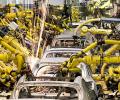
Passenger vehicle sales in India reached a record high of 4.7 million units in FY26, boosted by strong performances from major automakers and the implementation of GST 2.0.

Six months after its India debut, the Vietnamese automaker has overtaken established players such as Hyundai Motor, BMW, Kia, and Chinese EV major BYD.

Maruti Suzuki India on Wednesday expanded its product range in the country with the launch of all-new 'Victoris' as it looks to enhance its presence in the robustly growing mid-sized SUV segment.

BMW India has outpaced rival Mercedes-Benz India in luxury car registrations for the first quarter of calendar year 2026, driven by new product launches and a growing electric vehicle segment, even as the overall luxury car market remains largely flat.
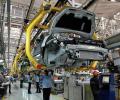
India's passenger vehicle (PV) industry is projected to experience moderated growth in FY27, following a strong rebound in H2FY26, primarily due to the high base effect, absorbed pent-up demand, and the lingering impact of geopolitical tensions in West Asia.
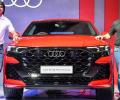
German carmaker Audi plans to reassess and adjust its product launch strategy in India once the specific details of import duty reductions under the India-EU free trade agreement (FTA) become clear, according to Balbir Singh Dhillon, the brand's director in India.

What we will not do is discount deeply, neither will we compromise on product substance, says Managing Director and Chief Executive Officer (MD&CEO) Santosh Iyer.

West Asia conflict triggers sharp sell-off in Indian markets, with realty, banking and auto stocks leading losses amid energy shock fears.

VinFast's VF6 storms into India as the most affordable electric SUV above 4 metres, packing premium features, 468km range, and free charging till 2028 to disrupt the EV market, observes Somnath Chatterjee.

JSW MG Motor India will launch four new models this year, and is planning to invest between 3,000 crore-4,000 crore in the country over the next couple of years. The new models include a plug-in hybrid, an electric vehicle, the Majestor SUV and one additional model yet to be disclosed.

Renault India has launched the all-new Renault Duster, featuring a turbo petrol engine and advanced features, with dispatches underway nationwide.

'Growth will definitely continue to come most from the sub-four-metre SUV segment, primarily because that is where the heart of economy and affordability is. Naturally, that will keep pushing the share of that segment (in overall PV sales) higher.'

Mahindras unveil four stunning, eye-popping, concept SUVs: the Vision.S, Vision.X, Vision.T, and Vision.SXT.

In 2025, the Maruti Suzuki Dzire has emerged as India's top-selling car, while sport utility vehicles continue to rule the broader passenger vehicle market, capturing almost 55 per cent of the segment.

Skoda India is focusing on cleaner fuel options, including CNG and EVs, while compact SUV Kylaq drives volumes, expands first-time buyers and strengthens the brand in India's competitive market

'In the January-August period, the share of hatchback in the overall PV industry sales was about 22.4 per cent. In the September-October period, the share of hatchbacks has come down to 20.4 per cent. In just October, their share was just 20 per cent. This is simple wholesale data from industry body SIAM.'

Leading automakers in India, including Maruti Suzuki, Tata Motors, Mahindra & Mahindra, and Hyundai, reported increased vehicle dispatches to dealers in February, driven by sustained domestic demand.
Leading automakers in India, including Maruti Suzuki, Tata Motors, Mahindra & Mahindra, and Hyundai, reported increased vehicle dispatches to dealers in February, driven by sustained domestic demand.

Mahindra pushes premium EV strategy with XEV 9e Cineluxe, blending luxury design, immersive technology and over 500 km range capability.

Maruti Suzuki will introduce eight SUVs over the next five years taking its overall model range to 28 as it aims to regain 50 per cent market share in the domestic passenger vehicle segment, Suzuki Motor Corporation Representative Director and President Toshihiro Suzuki said on Wednesday.

Lining up its 2030 strategy, Hyundai said it was targeting up to 30 per cent export contribution and over 1.5-fold rise in revenue, to cross the 1 trillion milestone in five years.

Japanese auto major Honda considers India a key market for its future growth alongside the US and Japan, according to Honda Cars India President and CEO Takashi Nakajima. The Tokyo-headquartered automaker, which operates in India through a wholly owned subsidiary, plans to drive in more SUVs in the country, as the segment continues to see robust sales across varied price points.

The small sports utility vehicle (SUV) segment - comprising models less than 4 metres in length - could witness the "maximum" growth among all categories in the coming months following the recent goods and services tax (GST) rate rationalisation, Tarun Garg, chief operating officer of Hyundai Motor India (HMIL), said.
Leading automakers Maruti Suzuki, Tata Motors, Mahindra & Mahindra, and Hyundai Motor India posted higher sales in January riding on the growth momentum ushered in by the GST reforms in the festive period last year.

Automobile retail sales rose nearly 18 per cent year-on-year to over 27 lakh units in January, led by continued post-GST momentum, healthy rural cash flows on the back of harvest and weddings, and sustained demand visibility across freight, dealer's body FADA said on Tuesday.

It is after seven years that a sedan has claimed the top spot -- Dzire had last achieved the No.1 position in 2018.
After a record-breaking year, India's automobile industry is entering 2026 on a relatively strong footing, with sales growth expected in the 6-8 per cent range. The outlook is underpinned by policy support, including GST rationalisation, easing monetary conditions, and income tax relief, which together are likely to improve affordability and sustain consumer demand across vehicle segments.

The 1.5-litre Hyperion petrol engine masterfully blends everyday driving with a sophisticated, tech-laden interior that elevates the entire experience.

However, with competition catching up, is the new Venue up to the challenge of fending off its rivals?

Tata Harrier.ev versus Mahindra BE.06 versus Mahindra XEV.9E -- which one should you buy? Rajesh Karkera offers a checklist of features to influence your decision.

It claims to be ahead of its competitors in the segment.

The operating performance of the country's largest passenger carmakers, Maruti Suzuki India (MSIL) and Hyundai Motor India (HMIL), in the July-September quarter (Q2) of 2025-26 (FY26) outpaced brokerage expectations.

Starting January, the market is expected to welcome models like the Tata Punch 2025 which is expected to be around 6 lakh, Mahindra BE 07 EV around 29 lakh, Maruti WagonR Electric around 8.5 lakh, Toyota 3-Row SUV around 14 lakh, and Volkswagen Tera to be around 8 lakh.

Maruti Suzuki's e-Vitara marks its high-stakes EV debut with strong export ambitions, lifting its stock even as analysts caution over pricing and fierce competition.
GSM, which is potentially eyeing a Hong Kong listing and was recently valued at $20 billion, operates on a distinct model -- it owns the e-taxis and employs the drivers, while also supplying cars to independent drivers or fleet operators.
 © 2026 Rediff.com - Advertise with us - Disclaimer - Privacy Policy - Sitemap - Feedback - About us - Terms of use - Grievances